

These are the questions Regina and Saskatchewan home buyers are asking most this fall, with direct answers and the sources behind them. Figures are current as of November 5, 2026 and I update this page as new market data comes out.
Key takeaways (October 2026)
- Regina’s average residential sale price was $352,310 in October, up about 3% from a year ago.
- Buyers have a bit more choice than last year, with about 2.3 months of inventory compared with 1.9 last October.
What does the Regina housing market look like right now?
Regina’s market slowed with the season in October, but supply is still tight. There were 320 residential sales in October, down from 432 in June, which follows the usual fall pattern. Active listings fell to 721 at the end of October from 787 in September. That works out to roughly 2.3 months of inventory, meaning that if no new homes were listed, the current supply would sell in a little over two months. That’s still a seller’s market by most measures, though less intense than June, when inventory sat at about 1.6 months.
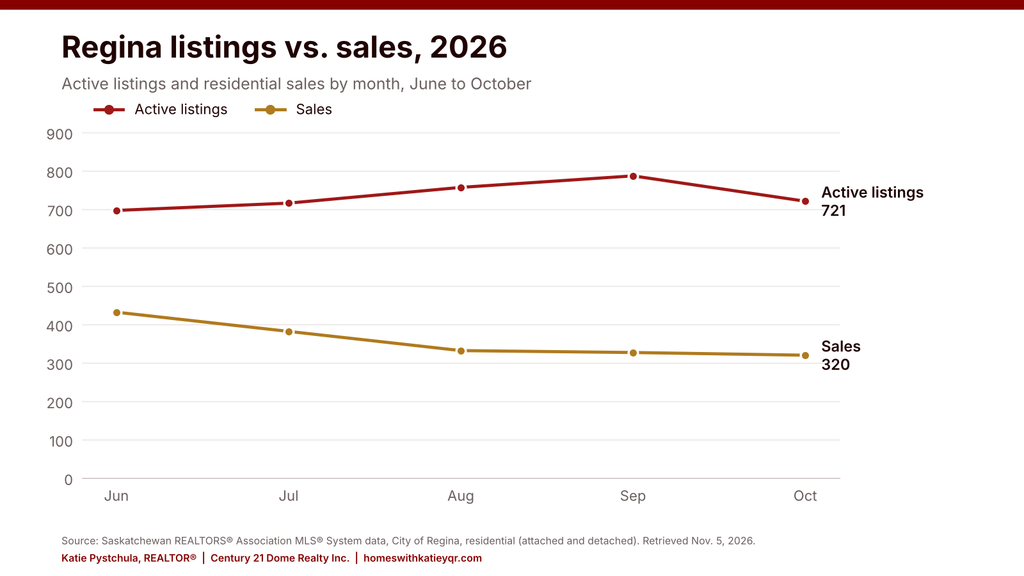
Homes are taking longer to sell. The average home sold in 32 days in October, compared with 25 days in June, and early November is running at about 37 days so far. The average October sale price was $352,310, about 97% of the average original list price of $362,546. In June, homes sold for close to 100% of their original price, and in July the average sale price came in above the average original list price as buyers competed for a limited number of homes during the busiest stretch of the year.
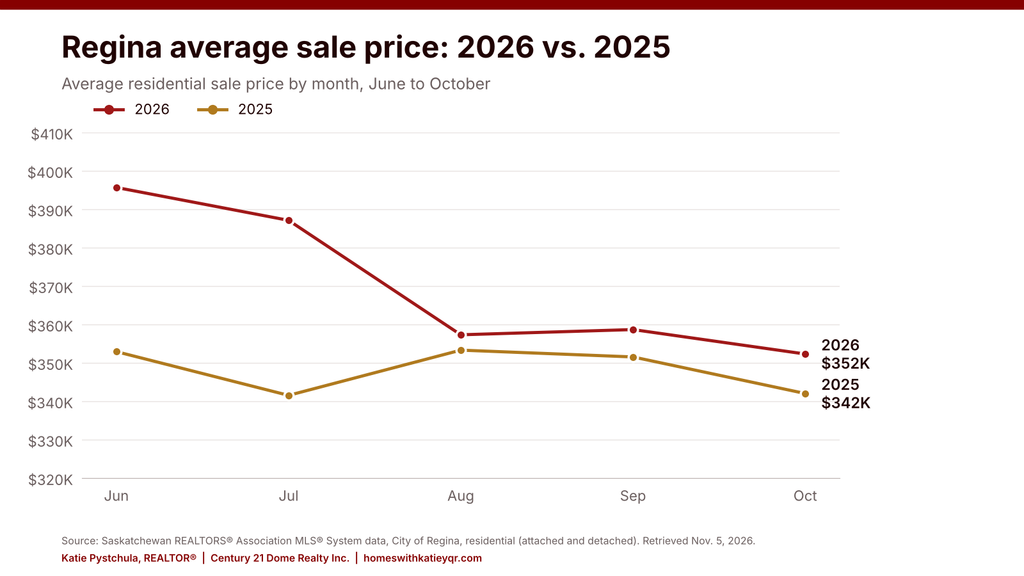
Compared with last year, buyers have a bit more choice, but prices have held firm. There were 721 active listings this October, about 6% more than the 683 in October 2025, while sales were down about 12% (320 vs. 362). That puts inventory at about 2.3 months, up from about 1.9 months a year ago. Even so, the average sale price rose about 3%, from $342,024 to $352,310, average days on market held steady at 32, and the average sale price was about 97% of the original list price, compared with about 94% in October 2025.
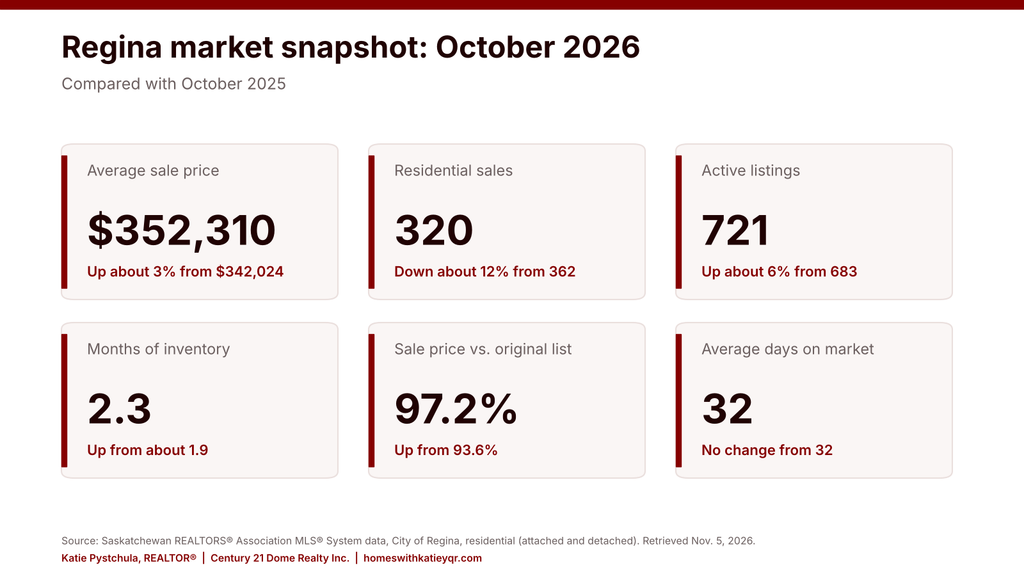
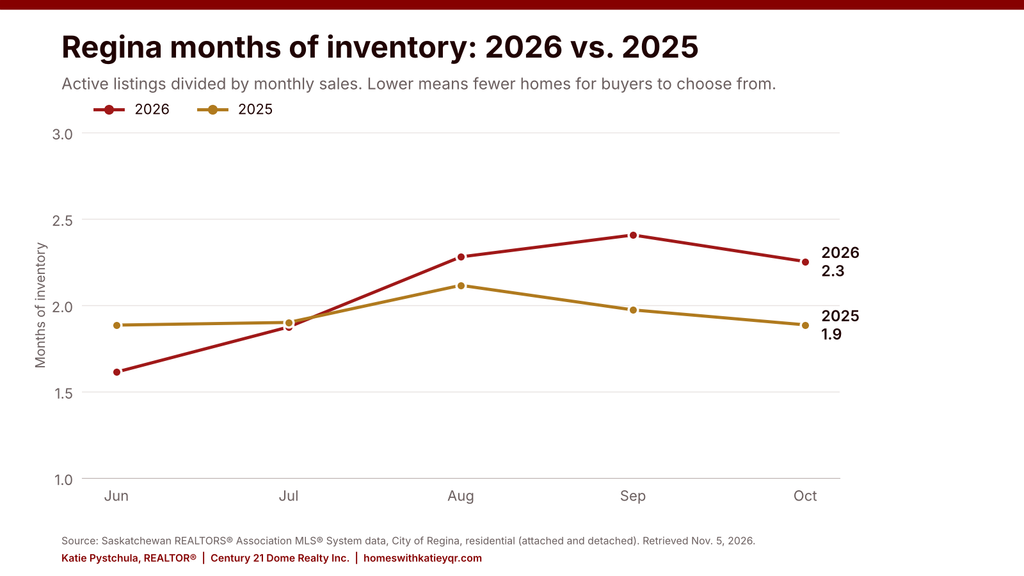
For buyers, this means you have a bit more time to view homes and weigh your options than in early summer, slightly more listings to choose from than a year ago, and more room to negotiate on price than during the summer months. Results still vary by home, price point and neighbourhood, so recent sales of comparable homes are the best guide for any specific offer.
Source: Saskatchewan REALTORS® Association MLS® System data, City of Regina, residential (attached and detached), retrieved November 5, 2026. Average sale price is a different measure from the SRA residential price quoted below, so the two figures won’t match. November days on market is month to date.
It can be, especially if you’re pre-approved and ready to move. Fewer buyers shop between November and February, so you may face less competition on a given home, but there are also fewer new listings to choose from. Regina has stayed a seller’s market through 2026 because inventory remains low, so the season changes the pace more than the overall balance. The quieter months often give buyers more time to view homes, book inspections and negotiate terms without feeling rushed.
Prices are up modestly compared with last year. The average residential sale price in the City of Regina was $352,310 in October 2026, about 3% higher than in October 2025 ($342,024), based on MLS® System data. The Saskatchewan REALTORS® Association’s residential price for Regina, which is calculated differently, was $343,900 in September, also up about 3% year over year. Prices vary widely by neighbourhood and property type, so recent sales of comparable homes are the best guide for any specific home.
It mainly affects variable-rate mortgages. On October 28, 2026, the Bank of Canada raised its policy rate from 2.25% to 2.50%, its first increase since July 2023. Variable mortgage rates and lines of credit tied to prime move up with it. Fixed mortgage rates follow bond yields instead, and several lenders had already raised fixed rates earlier in October. If you have a pre-approval, ask your lender whether your rate hold is still active and when it expires. The next scheduled rate announcement is December 9, 2026.
It depends on your budget, how long you plan to keep the mortgage and how much payment change you’re comfortable with. A variable rate rises and falls with the Bank of Canada’s rate, while a fixed rate keeps your payment steady for the term. The Bank has said further increases are possible, which makes this a good question to work through with a mortgage professional using your own numbers. I’m a REALTOR®, not a mortgage advisor, and I’m happy to connect you with local mortgage specialists I work with.
The minimum is 5% on the first $500,000 of the purchase price. You need 10% on any portion between $500,000 and $1.5 million, and 20% on homes over $1.5 million. At Regina’s September 2026 price of $343,900, a 5% down payment is about $17,195. With less than 20% down you’ll need mortgage default insurance, and in Saskatchewan PST applies to that insurance premium and is paid in cash at closing, so build it into your savings target. First-time buyers with an insured mortgage can also choose a 30-year amortization.
Saskatchewan has no land transfer tax. Instead, buyers pay a land titles transfer fee to ISC (Information Services Corporation), which works out to roughly $1,000 to $1,400 on a home at Regina’s September 2026 price, plus a fee to register your mortgage. Other closing costs include legal fees, title insurance, property tax and utility adjustments, a home inspection, home insurance and the PST on any mortgage default insurance. A common rule of thumb is to budget 2% to 3% of the purchase price for closing costs on top of your down payment. Your lawyer will confirm the exact amounts before possession day.
Saskatchewan buyers can stack several provincial and federal programs.
- Saskatchewan First-Time Homebuyers’ Tax Credit
- Federal Home Buyers’ Amount (line 31270)
- First Home Savings Account (FHSA)
- Home Buyers’ Plan (HBP)
- First-Time Home Buyers’ GST/HST Rebate (new homes)
- Saskatchewan PST Rebate for New Home Construction
- Métis Nation-Saskatchewan First-Time Home Buyers Program
Eligibility rules apply to each program, so confirm the details with your lender or accountant before you count on them.
Yes, on qualifying newly built homes. The federal First-Time Home Buyers’ GST Rebate became law on March 12, 2026. It refunds the full 5% GST on a qualifying new home priced up to $1 million (to a maximum of $50,000), with a partial rebate between $1 million and $1.5 million. Resale homes don’t qualify. Saskatchewan also offers a PST Rebate for New Home Construction of up to 42% of the PST paid on a newly built, previously unoccupied home, and applications are due within four years of your possession date. Both have eligibility conditions, so review them with your builder and lawyer before you sign.
Month to month, renting is often cheaper, but buying builds equity over time. Statistics Canada put the average asking rent for a two-bedroom in Regina at $1,480 a month in the second quarter of 2026. One October 2026 analysis that assumed 20% down found owning a typical Regina home cost about $440 more per month than renting once interest, property tax, insurance and maintenance were counted, with buying catching up after roughly 12 years. Your answer depends on your down payment, how long you plan to stay and the home you buy, so it’s worth running your own numbers.
Winter shows you how a home handles the cold, while snow can hide other issues. Pay attention to the furnace’s age and service records, drafts around windows and doors, condensation or frost on windows, ice buildup along the roof edge and whether the basement stays comfortable. Snow can cover the roof, lot grading, driveway and parts of the foundation, so ask the seller for photos or records from warmer months. Regina’s clay soils make foundation and basement checks worth extra attention, and for older homes a sewer line camera inspection is worth discussing with your inspector. A home inspection condition in your offer gives you time to do all of this.
Have a question that isn’t here?
If you’d like to talk through your own situation, you can reach me at 639-997-2060 or katie@homeswithkatieyqr.com. There’s no obligation, and if now isn’t the right time, that’s completely fine.
I’m a REALTOR® with Century 21 Dome Realty Inc. in Regina, not a mortgage advisor, accountant, lawyer or appraiser. This page is general information based on the public sources listed below as of November 5, 2026, and programs, rates and market figures change. Please confirm details for your own situation with the appropriate professional.
About the author: Katie Pystchula is a REALTOR® with Century 21 Dome Realty Inc. in Regina, Saskatchewan. Before real estate, she spent more than six years as a development consultant with an urban planning and communications firm in Vancouver, which shapes how she reads neighbourhoods, development and market data for her clients.
Sources
- Saskatchewan REALTORS® Association, September 2026 market release (Oct. 9, 2026), as reported by liv.rent, “Buy or rent in Regina in 2026?” (Oct. 27, 2026)
- liv.rent, Buy or rent in Regina in 2026?
- Ratehub, The Bank of Canada’s October 2026 rate hike
- Government of Saskatchewan, First-Time Homebuyers’ Tax Credit
- Government of Saskatchewan, PST Rebate for New Home Construction
- Canada Revenue Agency, First-Time Home Buyers’ GST/HST Rebate

Leave a Reply